
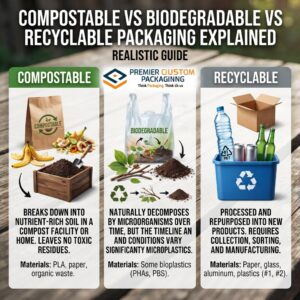
The term “eco-friendly” packaging is accompanied by confusing labels. Compostable, biodegradable, recyclable: these terms are similar but have different meanings. Understanding the difference will help you make the right decision and prevent false claims. Compostable vs biodegradable vs recyclable packaging explained in simple and clear terms.
Why do these words get confused?
Start with the confusion itself. These three words are confused because they all sound like “green,” but they have different meanings.
Many people use them interchangeably, and some brands do, too, which adds to the confusion. In reality, each term refers to a different aspect of packaging’s impact on the planet at the end of its life. It’s important to get them right for genuine marketing and genuine eco decisions. Premium Custom Packaging can be any of the three, so knowing the difference helps you choose well.
These terms are confused because they:
- All sound eco-friendly.
- Are used loosely.
- Mean different things.
The first real step to a smart, honest, informed choice is to understand each one clearly.
What is meant by Recyclable Packaging?
Think of the most frequent word first. Recyclable packaging can be gathered, treated and turned into a new product.
Recyclable material, such as cardboard or some plastics, is placed in a recycling bin and is used to make a new product rather than waste in a landfill. If your local facilities don’t accept and process that material, it’s not truly recyclable. Paper and cardboard boxes are widely recyclable and are a good, safe, eco option. Recyclable: Material that is used again for a purpose.
Recyclable packaging:
- Is collected and reprocessed.
- Becomes a new product.
- Needs local recycling support.
Recyclable packaging is just recycling old material into something useful and new.
Biodegradable Packaging: What Does It Mean?
Now the most difficult term. Biodegradable packaging refers to packaging that can be broken down over time, but the definition is not specific.
Biodegradable just means that the material will be broken down by microbes over time into natural elements. The issue is that eventually is never, it could be months or many years. The word is the most misused of the three because there are no fixed legal rules for it. While biodegradable is a good thing, there’s a hidden detail.
Biodegradable packaging:
- Breaks down naturally.
- No set time limit.
- Is the least specific term.
Biodegradable is the most sensitive word to use.
What Compostable Packaging Means
Now the harsher of the two terms. Compostable packaging is a material that can be broken down into a natural, safe material within a specified time and under specific conditions.
Compostable is much more specific than biodegradable. It is the packaging that becomes compost, without leaving any harmful residue, within a defined and tested period. Some is garden compostable, others require a proper industrial composting facility. Certification is the only way to ensure that a product actually complies with these rigorous requirements. Compostable is the most unambiguous and reliable green label.
Compostable packaging:
- Degrades into safe compost.
- Has set rules and timeframes.
- May require industrial composting.
Compostable is the most precise and reliable of the three.
The Key Differences at a Glance
Compare them. The three terms are different in what happens to the material and how quickly.
Recyclable is transformed into a new product. Biodegradable: breaks down naturally, but not at a fixed time. Compostable is broken down into safe compost within clear rules. Wholesale Premium Custom Packaging can be recyclable or compostable without sacrificing a premium look. They’re all good, but they’re not the same, and it’s important to know the difference so you can select and market honestly.
The main differences are:
- Recyclable: made into new products.
- Biodegradable: breaks down, no set time.
- Compostable: becomes compost, set rules.
Each term has a specific meaning, use the appropriate term.
Which One to Use?
Now the real question. It depends on your product, your buyers and your goals.
Recyclable packaging is suitable for most brands and convenient for customers to handle at home. Compostable is ideal for food or natural brands with a clear and strong green story. Biodegradable alone is best avoided unless you can be specific and honest about exactly what it means. The right choice is the one that is honest and truly suits your product and your market.
Choose based on:
- Your product type.
- Your buyers’ values.
- What your area supports.
Choose the one that is both truthful and feasible for you.
Be Honest About Your Claims
The most important rule now. Only use the eco claim that you can substantiate.
Greenwashing is easy to detect by both buyers and regulators, and can damage your brand. Only say “recyclable” if it is, and “compostable” only if it is and with proof and certification. Don’t use the term “biodegradable” without clarifying what this means for your product. Only use words that are real and specific in every claim you print. Truthful claims create trust, false claims destroy it quickly.
To keep claims honest, do:
- Supporting each statement with evidence.
- Where possible, use certifications.
- Not using ambiguous green words.
- Real eco marketing is based on honesty.
Final Thoughts
Compostable, biodegradable and recyclable are not synonymous. Recyclable is transformed into new products, biodegradable is broken down over an unknown period of time, and compostable is converted into safe compost within established guidelines.
Recyclable and certified compostable are the most obvious and reliable options for most brands, and “biodegradable” should be taken with a grain of salt. Never overstate your claim.
You don’t sacrifice a green story for a premium feel with Wholesale Premium Custom Packaging, as you can select recyclable or certified compostable options. Do it right and you’re making a difference for the planet and marketing honestly. Clear and accurate eco claims are good for the environment and good for your brand’s trust.