
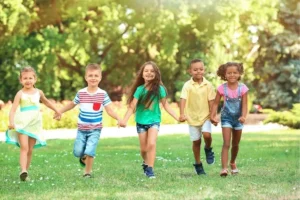
Children are spending less time outdoors than ever in many locations around the world. Around the world, children spend less time outside than they have in the past. An examination of some research evidence suggests that girls, children from racial/ethnic groups that are not the majority, and those growing up in cities may be less inclined to go outside and play. Also, kids don’t play out as much the older they are, but outdoor play is healthy for all ages. Although children are spending less time outdoors, more and more research demonstrates the importance of outdoor play in children’s growth and development. Numerous studies have demonstrated that being outside, particularly when allowed to play freely, can aid children’s health, social skills, and attention and readiness for learning within the school environment like the Childcare Nursery.
Active play inspires physical development:
Children are internally motivated learners. They move their bodies as they go outdoors in ways which help them to grow stronger, more balanced, more coordinated, and better at using their muscles. Child development of gross motor skills and body awareness is represented through simple ground motions such as jumping, running, climbing, throwing, and balancing. The changing levels of exercise enable children to achieve good development and grow in confidence to control their bodies. Play outdoors gives children more space to be active, investigate, and be adventurous; they are free to be more independent in a safe and supportive environment.
It nurtures kids’ confidence when they play outdoors
Some of the things a kid will have to try are fun and a little challenging. Children are able to engage in small, safe risks that are developmentally appropriate, such as climbing a bit higher, walking on a narrow beam, or experiencing novelty in the presence of something in their hands outdoors. Kids bloom when they achieve success. They understand to give something a second go if it is difficult at first. These moments additionally assist kids to build strength, inhibitory control, and self-confidence. This type of learning is effective, as children are not merely listening; they are experiencing for themselves, and they can do things.
Social Skills Grow Through Outdoor Play
Kids tend to have more fun and engage in more cooperative play, flexible up-and-down thinking, and communication with others in outdoor play. Children play together, setting up a pretend restaurant, a game, collecting natural materials, playing on equipment, taking turns, etc. Children are able to practice some key social skills: “sharing”, “taking turns”, “problem solving”, “listening to others”, “sharing own ideas” and “co-operating as a group”. Outdoor play is an open-ended experience; children are allowed to make up their own games and are given opportunities to plan their own play and games with their peers.
Our emotional condition is nurtured outdoors
New ambient air, movement, and space for children’s movement can lead to a feeling of well-being and help to regulate their emotions. Children’s outdoor play allows them to be physical and feel good while also helping to relieve tension from their indoor structured play. The feeling of freedom and peace being outdoors is a joy to many children. It allows them to engage in activities that are ‘real and important’ and discussed with them, whilst in turn giving them the opportunity to interact with their environment.
Help your child enjoy the outdoors:
For kids, there are a number of barriers to outdoor play time. At times families may be asked to support in ways that they initially did not intend to. A child’s playing time outside isn’t as vital to their development as a sport or studying, which is easy to see. But this is untrue.
Other temptations to stay put sometimes involve concerns about the rain and getting muddy. As long as they are dressed appropriately and are not uncomfortable, children should not be denied the opportunity to enjoy outdoor play.
Not many people realise it, but we too share thoughts on how many kids should have more exercise or whether a kid is safe enough to join in with exciting, active play. In particular, girls are not as often sent outside to play as boys are. As the kids grow older, they tend to have less time for playing outside. But girls, older kids, and teenagers also get just as much help from playing outside as younger children do.
Of course, not everyone has a backyard or a close forest for kids to play in. More children are growing up in cities, and because of that, they are not getting as much time in nature or green spaces. Children do not always play safely outside, for example, when there are running cars on the street, smoky air, or very hot weather. In the event that they are in one of these situations, it is essential that they keep in mind that they are better off with something than without it.
A small study, for instance, showed that a 20-minute walk in a park was more effective at improving children’s ADHD attention than just a walk in an urban area or their usual neighbourhood. Maybe the family could make a change or two to the usual routine, like walking through a park or a part of a woodland, for example, to (and from) school.
Final Words
Externally, play contributes to children’s development in all sorts of ways: physically, socially, emotionally and mentally. Playing outdoors is vital to the growth and development of young children. It assists children to get around, inquire, problem-solve, make connections, make friends and feel good about themselves. Children are encouraged to be curious, competent and confident in their learning opportunities and are given opportunities to explore and to learn more about the world.
Visit bushwood for more informative blogs.