
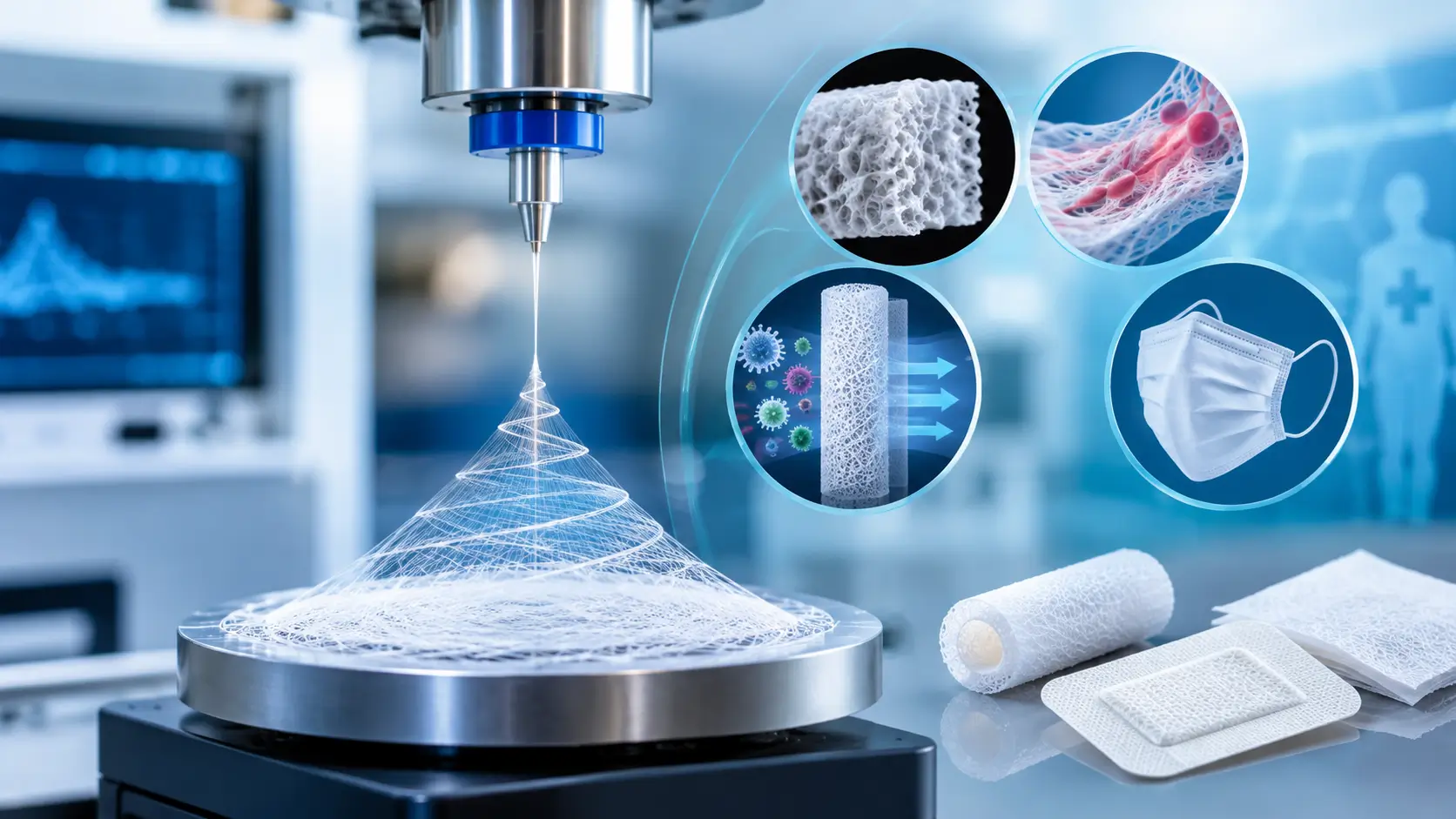
The future of healthcare is being built at a scale far smaller than the human eye can see. Across the United States, researchers, device manufacturers, and biotech startups are turning to medical electrospinning to create materials that heal wounds faster, deliver drugs more precisely, and help the body rebuild damaged tissue.
Electrospinning is not a new idea, but its role in medicine has grown rapidly over the past two decades. Today, electrospun nanofibers for medical applications are moving from university labs into clinical products. In this article, we explain how medical electrospinning works, why nanofibers matter, where they are being used, and how companies like Matregenix are helping bring this technology to market.
What Is Medical Electrospinning?
Medical electrospinning is a manufacturing process that uses a high-voltage electric field to draw a polymer solution or melt into extremely fine fibers. These fibers typically range from a few tens of nanometers to a few micrometers in diameter, often hundreds of times thinner than a human hair.
How the Electrospinning Process Works
The basic setup is simple, which is part of its appeal:
- Polymer solution: A biocompatible polymer, such as PCL, PLGA, collagen, gelatin, or chitosan, is dissolved in a suitable solvent.
- Electric charge: The solution is pushed through a fine needle or nozzle while a high voltage is applied.
- Fiber formation: The electric force stretches the liquid into a thin jet. As the solvent evaporates, the jet solidifies into a continuous nanofiber.
- Collection: The fibers land on a grounded collector, forming a non-woven mat, a tube, or an aligned fiber sheet.
By adjusting voltage, flow rate, polymer concentration, and collector design, engineers can control fiber diameter, porosity, alignment, and thickness. This level of control is what makes biomedical nanofiber technology so valuable to device designers.
Why Nanofibers Matter in Modern Medicine
The human body is built on nanoscale structures. The extracellular matrix (ECM), the natural scaffold that supports our cells, is made of protein fibers with diameters in the nanometer range. Electrospun nanofibers closely mimic this structure, which gives them several key advantages:
- High surface area: Nanofiber mats offer a very large surface area relative to their volume, improving cell attachment and drug loading.
- Tunable porosity: Interconnected pores allow oxygen, nutrients, and moisture to pass through while blocking bacteria.
- Material flexibility: Natural, synthetic, and blended polymers can all be electrospun, including biodegradable options.
- Functional loading: Drugs, growth factors, antimicrobial agents, and nanoparticles can be built directly into the fibers.
Together, these properties allow biocompatible nanofiber materials to interact with living tissue in ways that conventional textiles, films, and foams cannot.
Key Applications of Electrospun Nanofibers in Healthcare
Medical electrospinning is now used across a wide range of clinical and research areas. Here are the applications driving the most innovation in the US healthcare market.
Nanofiber Wound Dressings
Chronic wounds, such as diabetic foot ulcers, pressure ulcers, and venous leg ulcers, affect millions of Americans and cost the healthcare system billions of dollars each year. Nanofiber wound dressings offer a smarter approach to wound care. Their fine porous structure keeps the wound moist while letting it breathe, and it acts as a physical barrier against bacteria.
Manufacturers can also load these dressings with silver, antibiotics, or plant-based antimicrobials for controlled release at the wound site. Because the fibers resemble natural tissue, they can support cell migration and help speed up the healing process.
Tissue Engineering Scaffolds
Tissue engineering aims to repair or replace damaged tissue by giving cells a structure to grow on. Electrospun tissue engineering scaffolds are among the most studied platforms in regenerative medicine because they replicate the native ECM so closely.
Researchers are developing electrospun scaffolds for:
- Skin regeneration and burn treatment
- Vascular grafts and heart valve tissue
- Nerve guidance conduits
- Bone, cartilage, and tendon repair
Aligned fibers can guide cells to grow in a specific direction, which is especially useful for nerve, muscle, and tendon applications. Biodegradable polymers allow the scaffold to dissolve gradually as new tissue forms.
Drug Delivery Nanofibers
Drug delivery nanofibers allow precise, localized, and sustained release of therapeutic agents. Instead of flooding the whole body with medication, a nanofiber implant or patch can deliver a drug exactly where it is needed.
Using techniques such as blend, coaxial, and emulsion electrospinning, engineers can control how quickly a drug is released, from minutes to several weeks. This approach is being explored for cancer therapy, post-surgical infection control, pain management, and transdermal patches. It can reduce side effects and improve patient outcomes.
Nanofiber-Based Medical Devices
Beyond dressings and scaffolds, nanofiber-based medical devices are appearing in many forms. Examples include coatings for stents and implants, surgical meshes, hernia repair products, high-efficiency filtration media for masks, biosensors, and membranes for guided bone regeneration in dental procedures. In each case, the nanofiber layer adds performance that bulk materials cannot match.
From Lab to Market: Producing Medical-Grade Nanofiber Materials
Creating a nanofiber sample in a research lab is one thing. Manufacturing medical-grade nanofiber materials at commercial scale is another challenge entirely. For US medical device companies, three factors matter most.
Biocompatibility and Material Selection
Every material that contacts the human body must be safe. Biocompatible nanofiber materials are selected and tested to avoid toxic, inflammatory, or allergic reactions. Residual solvents must also be controlled carefully, since some solvents used in electrospinning can be harmful if traces remain.
Consistency and Scalability
Medical products demand batch-to-batch consistency in fiber diameter, thickness, and porosity. Needleless and multi-nozzle electrospinning systems, along with tight process monitoring, now make it possible to scale production while maintaining strict quality standards.
Regulatory Readiness
In the United States, nanofiber-based products must meet FDA requirements for their device class. This includes documented quality systems, validated manufacturing processes, sterilization compatibility, and biocompatibility testing. Partnering with an experienced electrospinning manufacturer can significantly shorten the path from prototype to FDA submission.
How Matregenix Is Advancing Medical Electrospinning
Matregenix specializes in electrospinning and nanofiber technology, helping medical and biotech innovators turn ideas into real products. By combining materials science expertise with advanced electrospinning equipment, Matregenix supports clients across the full development journey:
- Custom material development: Designing nanofiber formulations tailored to specific clinical needs.
- Prototyping and R&D: Rapidly producing samples to test fiber structure, drug release, and performance.
- Scale-up manufacturing: Moving from small batches to consistent, commercial-volume production.
- Equipment and process expertise: Providing electrospinning systems and process knowledge for in-house development.
Whether a company is building a next-generation wound dressing, a regenerative scaffold, or a targeted drug delivery platform, Matregenix helps bridge the gap between laboratory innovation and market-ready medical products.
The Future of Medical Electrospinning
The next wave of innovation is already taking shape. Researchers are combining electrospinning with 3D printing to build complex, multi-layered tissue structures. Smart nanofibers that respond to pH, temperature, or infection markers could release drugs only when needed. Electrospun materials are also being paired with stem cells, wearable sensors, and personalized medicine.
As demand for minimally invasive treatments and faster healing grows, medical electrospinning will remain a core technology in the development of next-generation medical materials.
Conclusion
Medical electrospinning is transforming how we design materials that work with the human body. From nanofiber wound dressings and tissue engineering scaffolds to drug delivery nanofibers and advanced medical devices, electrospun nanofibers offer a rare combination of precision, versatility, and biological compatibility.
For medical technology companies in the USA, the opportunity is clear: nanofibers can create better products and better patient outcomes. If you are exploring nanofiber solutions for your next medical product, contact Matregenix to discuss how our electrospinning expertise can help you move from concept to commercialization.
Frequently Asked Questions (FAQs)
1. What is medical electrospinning?
Medical electrospinning is a process that uses a high-voltage electric field to turn polymer solutions into ultra-fine nanofibers. These fibers are used to make wound dressings, tissue scaffolds, drug delivery systems, and other medical devices that mimic the body’s natural tissue structure.
2. What materials are used to make electrospun nanofibers for medical applications?
Common materials include synthetic polymers such as PCL, PLA, PLGA, and polyurethane, and natural polymers such as collagen, gelatin, silk fibroin, and chitosan. Many products blend natural and synthetic polymers to balance strength, flexibility, and biocompatibility.
3. How do nanofiber wound dressings help wounds heal faster?
Nanofiber wound dressings maintain a moist healing environment, allow oxygen exchange, and block bacteria. They can also release antimicrobial agents or growth factors directly into the wound, and their ECM-like structure supports the cell growth needed for tissue repair.
4. Are electrospun nanofiber products approved by the FDA?
Several electrospun and nanofiber-based products are already cleared or approved for use in the United States, mainly in wound care and surgical applications. Each new product must still go through the FDA pathway that matches its device class, including biocompatibility and safety testing.
5. Can medical electrospinning be scaled for commercial production?
Yes. Advances such as needleless electrospinning, multi-nozzle systems, and automated quality control now allow consistent, large-scale production of medical-grade nanofiber materials. Experienced partners like Matregenix help companies scale from R&D samples to commercial manufacturing.